


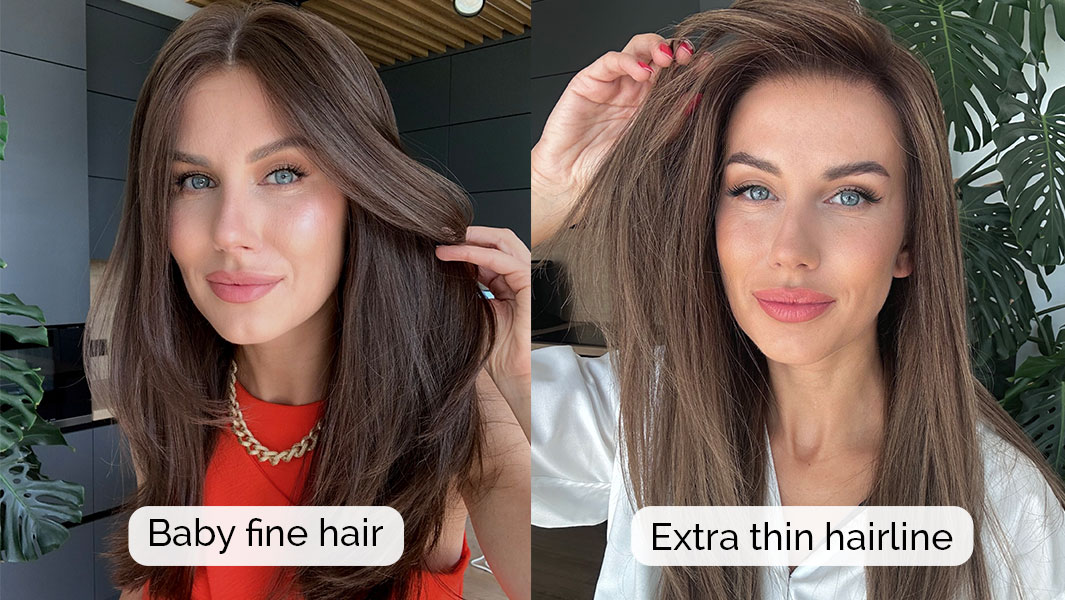
For those just beginning to explore the wig market, terms like fine human hair wigs or extra thin hairline wigs can often seem similar – sometimes even like alternative names for the same product. However, given that we are raising this question, one can assume that this is not a case of synonyms, but rather two distinct types of wigs.
Although both categories are associated with authenticity, lightness, and a realistic appearance, they are based on different principles. Not only does the type of hair used differ, but so do the purpose of the wig’s creation and the final result sought.
For this reason, when choosing between fine human hair wigs and extra thin hairline wigs, it’s important to consider more than just the wig’s appearance. You should also look at what lies beneath the surface, from hair structure to construction methods. That is exactly what we will discuss today: how these two options differ and how to determine which choice best suits your needs.
Table of Contents
Quick answer: what’s the difference?
- Fine human hair wigs (also known as baby fine hair wigs) are made from European Slavic children’s hair, which is extremely fine, resulting in a wig with lower density across the entire scalp.
- Extra thin hairline wigs (also known as natural hairline wigs) focus not on the overall density of the wig, but on a thinner, lighter hairline (which creates a more natural hair growth effect). The rest of the wig can vary in density.
- If you’re looking for the best wigs for very fine hair or a natural-looking low density, choose fine human hair wigs.
- If your main priority is a seamless hairline and the ability to wear your hair away from your face, extra-thin hairline wigs will be a better fit.
- Both types of wigs can look very natural. The only difference is whether you’re aiming to replicate the texture of fine hair or achieve the most realistic hairline effect possible.
What are fine human hair wigs?
When it comes to fine human hair wigs, we should make it clear that this isn’t just any wig with a lower density. We use this term to describe a specific category within the HAIRALICIOUS® collection: baby fine hair wigs. Due to the characteristics of the hair texture, these human hair wigs are produced in extremely limited quantities. This is not a mass-produced product, but rather a niche collection designed for a specific need.
Key features
- Made from baby fine hair (European Slavic hair).
- Naturally lower volume throughout the entire wig.
- A gentle, flowing, soft texture.
- Shiny, never dyed virgin hair.
What makes fine human hair wigs unique (and why they’re considered premium)
The greatest distinction of fine human hair wigs lies in the hair itself. These wigs are made using baby fine hair – extremely thin, natural European (Slavic) hair sourced from child donors. This type of hair naturally has a significantly smaller diameter than the standard European or Brazilian hair used in most other human hair wigs.
Most importantly, the reduced volume here is achieved not by using a smaller amount of hair distributed across the cap, but by employing a completely different hair type. Each strand of hair is finer, lighter, and softer, so even with a similar amount of hair, the overall result looks more delicate.
This distinction is especially important, as simply reducing density in a wig made from thicker hair can lead to practical issues, such as the base or wefts becoming more visible. For this reason, achieving a natural low-density look is not just about using less hair, but about using the right type of hair.
It is precisely this characteristic that allows such fine human hair wigs to accurately replicate the appearance of naturally fine hair, rather than imitating it through artificially reduced density. That is why, for those seeking the most natural low-density result, baby fine hair wigs are considered one of the most effective solutions.
Due to the extremely limited availability of European Slavic hair on the market, baby fine hair wigs are produced in small quantities and remain one of the rarest product categories. Not only does this ensure their exclusivity, but it also guarantees a higher standard of quality, as each wig is crafted from meticulously selected hair. For this reason, this category is often considered one of the best choices for those seeking the best wigs for very fine hair, where authenticity takes precedence over volume.
Baby fine hair wigs are the best for
Fine human hair wigs are best suited for the following situations:
- If you have naturally fine hair and want the wig to look like an extension of your own hair. In this case, wigs with thicker hair may look too “heavy” and not match your natural appearance, so wigs for fine, thin hair help maintain realism.
- When the goal is not a dramatic transformation but a subtle, everyday look. These wigs don’t create excessive volume and look light and natural.
- If comfort and lightness are your priority. Due to the smaller hair diameter, these thin wigs are slightly lighter, making them comfortable for long-term wear.
- If you want a wig that matches not only the look, but also the texture and color of your natural fine hair. Baby fine hair wigs are especially suitable for children or anyone seeking a softer, more delicate hair structure, as well as undyed, natural tones that remain stable over time..
- If you prefer virgin, non-dyed hair. Since baby fine hair wigs are made from undyed hair, the color does not fade or change over time like dyed hair could.
- If you’re new to wigs and want an easy, comfortable application. Thanks to their lace front construction with firm ear tabs, fine hair wigs are beginner-friendly, while still allowing to glue the lace at the front if desired.
Trade-offs of fine human hair wigs
Although fine human hair wigs stand out for their premium quality and subtle appearance, the hair structure also has some practical nuances. Due to their thinness, such hair can be more sensitive to mechanical stress, so in longer styles, it tends to tangle a bit quicker. Also, since the overall density is lower, natural hair shedding may be more noticeable than in other natural hair wigs that use thicker-diameter hair.
It’s important to remember that these wigs aren’t designed to create dramatic volume or a “full volume” effect. Their purpose is to accurately replicate naturally fine hair, so for those expecting a denser or more dramatic result, they may seem too subtle. For this reason, fine human hair wigs work best as a highly targeted solution – one of the best choices for those who prioritize naturalness over volume.
What are extra thin hairline wigs?
When it comes to extra thin hairline wigs, it’s important to understand that we’re no longer talking about strand thickness or overall wig density, but rather about one specific structural element – the wig hairline.
The HAIRALICIOUS® collection includes wigs that focus specifically on achieving a more natural-looking wig hairline. This collection is called Extra Thin Hairline Glueless Wigs.
Unlike the baby fine human hair wigs just discussed, the natural look here is achieved not through the hair structure, but through an extremely meticulously crafted wig hairline construction. Extra thin hairline human hair wigs can have varying (both lower and higher) density throughout the wig, but the hairline always remains lighter, more subtle, and as realistic as possible.
Key features
- Extremely thin, transparent HD lace material that allows the wig hairline to blend seamlessly with the skin.
- Pre-plucked hairline.
- Fine, well-bleached knots for a more natural effect.
- Lower density specifically at the hairline and around the face, rather than throughout the entire wig.
- Longer baby hairs around the face.
What makes extra thin hairline glueless wigs unique
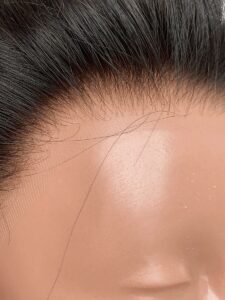
The greatest distinction of extra thin hairline wigs lies in how the natural hair growth line is recreated. In these natural hair wigs, the primary focus is not on the overall hair volume or texture, but on achieving a realistic hairline that seamlessly blends with the skin. This effect is primarily created through the use of an ultra-thin lace base, which is nearly invisible and adapts to the skin tone, combined with finely bleached knots that minimize visible dark points and enhance the illusion of hair growing directly from the scalp.
To further refine this natural effect, several layered solutions are applied: lower density at the front, individually hand-tied hair, extremely fine bleached knots, and a pre-plucked hairline. All of this results in a realistic, slightly imperfect hairline effect characteristic of real hair.
Importantly, unlike fine hair wigs, in this case, naturalness isn’t about the total amount of hair in the wig. The wig can have medium or higher density, but the front section remains subtle and lighter. As a result, the wig achieves a natural, gradual transition from the hairline to the rest of the hair, regardless of overall density.
Extra thin hairline wigs are best for
Extra thin hairline wigs are best suited for the following situations:
- If you’re looking for a wig with a naturally lighter hairline that gradually increases in density towards the crown. This type of structure closely mimics natural hair growth patterns.
- If you often wear your hair away from your face (e.g., in a bun or ponytail), the natural hairline of this wig allows you to do so while maintaining a maximally realistic look.
- If you prefer a softer, lower-density hairline that mimics natural hair growth at the front. Not everyone has a dense hairline, so extra thin hairline wigs are a great option for those who want to replicate a more delicate, less defined hairline.
- If you want to combine a natural hairline with more volume. Unlike baby fine hair thin wigs, it is possible to have more density all around the scalp.
- If you want long hair that is easy to maintain. Natural hairline wigs tend to tangle less, while baby fine hair wigs are more prone to tangling at longer lengths due to their finer strands.
- If you’re looking for an overall imperfectly natural look. These natural hairline wigs have single-drawn hair, meaning the strands gradually become thinner towards the ends, creating a slightly imperfect look similar to real hair.
- If you often wear your hair wavy, as these wigs feature a slightly coarser texture that holds curls well and can be scrunched when wet to create a natural wave pattern.
The secret behind a natural-looking hairline
The natural look of extra thin hairline wigs comes from a combination of various construction details designed to replicate real hair growth as closely as possible. A softer, lower-density hairline is created using a pre-plucked front, small well-bleached knots, and fine baby hairs, all working together to reduce visibility at the base. Furthermore, the use of thin, transparent HD lace allows the wig hairline to blend seamlessly with the skin, while its shape is designed to look slightly irregular rather than perfectly straight. In addition, the lace can be glued from ear to ear if preferred.
It is important to note that if you have dark natural hair, it may take more effort to ensure it doesn’t show through the lace base. Furthermore, while these natural hair wigs provide a very realistic effect at the front, the overall density of the wig may vary, and instead of replicating the look of naturally fine hair across the entire head, they mimic the natural thinning of strands toward the ends.
For this reason, extra-thin hairline wigs work best when the priority is a flawless hairline rather than overall thinness of the hair.
Core differences
| Feature | Fine human hair wigs (baby fine hair wigs) | Extra thin hairline wigs (natural hairline wigs) |
| Main focus | Hair type (baby fine hair) | Hairline construction |
| Natural look achieved through | Hair texture, smaller hair diameter | Bleached knots, baby hairs and pre-plucked hairline |
| Overall density | Lowest possible | Can vary from medium to high |
| Result | Soft, subtle look that mimics naturally fine hair | Highly realistic hairline at the front which gives a lightweight and natural appearance even with overall higher density of the wig |
| Hair type | European Slavic baby fine hair | European or Brazilian hair |
Which wig looks more natural?
Regarding which looks more natural – fine human hair wigs or extra thin hairline wigs – it’s important to understand that both options actually look extremely realistic. The difference lies in how that natural look is achieved.
Fine human hair wigs provide a natural look of thin hair across the entire wig. Thanks to the extremely fine baby-fine hair, they precisely replicate the texture, fall, and overall volume of naturally fine hair. For this reason, such wigs are often considered one of the best choices to achieve a look that resembles your own fine hair – not too thick, not too “perfect.”
Meanwhile, extra thin hairline wigs (or natural hairline wigs) create a natural look primarily in the front section. This doesn’t mean the rest of the wig looks less natural – a lot of work goes into them as well – but the main focus is on a realistic wig hairline. This results in a hairline that mirrors natural growth, with a softer, more sparse front that gradually increases in fullness toward the back.
Therefore, the answer isn’t clear-cut, because the most natural-looking wig will be the one that best suits your individual situation.
- If you’re looking for the thinnest and lightest wig available → fine human hair wigs will be the best choice.
- If your natural hairline is more sparse and you want to replicate that, or if you prefer a fuller overall density while maintaining a natural-looking hairline → extra thin hairline wigs will be the better choice.
How to choose the best option for your needs: Ask yourself
- Is your natural hair fine, and do you want the wig to look like an extension of it? If so, baby fine human hair wigs are usually the more natural choice.
- Do you often wear your hair pulled back from your face (e.g., ponytail, bun)? In this case, the wig hairline becomes more important, so extra thin hairline wigs are a better fit.
- Which aspect of naturalness matters more to you – overall hair fineness or a realistic thin hairline?
- For ultra-fine, soft hair throughout – baby fine hair wigs.
- For a realistic thin hairline – extra thin hairline wigs.
- What hair texture do you prefer?
- For silky, smooth, naturally straight hair – baby fine hair wigs.
- For a slightly coarser texture that holds curls and waves better – extra thin hairline wigs.
Can you combine both features in one wig?
Theoretically, you might think it’s possible to find solutions that combine both the effect of thinner hair and an extremely natural wig hairline. However, in practice, these two aspects are usually developed separately, and there is a reason for this.
Fine human hair wigs (baby fine hair wigs) and extra thin hairline wigs (natural hairline wigs) are based on different design principles. In the first case, the main focus is on the hair – its diameter, softness and how it falls across the wig. In the second case, the priority is the construction – how to create the most natural transition between the skin and hair at the wig hairline.
The problem is that these two goals require a different balance between naturalness and construction. Baby fine hair is extremely thin and lightweight, which means that pushing the density even lower (especially around the hairline) would not be practical. With such fine hair, individual hair loss becomes more visible, which can affect how the wig looks over time and reduce its longevity. It is also not possible to create higher density or longer hair length from this type of hair, as it would tangle easily.
Meanwhile, extra thin hairline wigs are focused on the opposite effect – to minimize the density in the front part and create the least visible transition between the skin and the hair. For this, extremely thin lace, very delicate binding and a thinned wig hairline are used, which allows for an extremely realistic growth effect.
That is why these solutions are usually developed separately, and not combined in one product to the maximum. In the HAIRALICIOUS® range, baby fine hair wigs are classified as Lace front wigs.
Ultimately, it comes down to prioritization. If your goal is to replicate the look and feel of naturally fine hair, fine human hair wigs will deliver the most authentic result. If, on the other hand, your focus is on achieving an undetectable wig hairline, extra thin hairline wigs will be the better choice.
Find your most natural match
Whether you’re looking for the lightness of baby fine hair or the realism of an extra thin hairline, explore the Hairalicious® collections designed for a naturally effortless look.
FAQ
What is the difference between baby fine hair wigs and extra thin hairline wigs?
The difference is that baby fine hair wigs describe the hair type and overall density of the wig, while extra thin hairline wigs refer to the construction of the hairline. In the first case, the natural look is achieved through an extremely fine hair diameter; in the second, through a realistic wig hairline.
Which wig is better for natural look?
There is no single best option, as it largely depends on your individual needs when looking for a wig. If you have naturally fine hair and want to replicate that look, fine human hair wigs are a better choice. If a natural thin hairline is your top priority, you should opt for extra thin hairline wigs.
Are baby fine hair wigs good for thinning hair?
Yes, baby fine hair wigs are an excellent choice for those with thinning hair, especially if you are used to fine hair and do not want a drastic change, so as not to feel overwhelmed. HAIRALICIOUS® baby fine hair wigs belong to the Lace front wig category, which features a lightweight, breathable base. This construction allows the scalp to “breathe,” does not cause excessive pressure, and (just like all our wigs) can be worn without adhesives, making it suitable for sensitive scalps or thinning hair.
What is an extra thin hairline wig?
This is a wig designed to create an extremely realistic hairline. Extra-thin hairline wigs use fine lace, delicate weaving, and lower density at the front to mimic natural hair growth.
Can extra thin hairline wigs work for fine hair?
Yes, they can. Extra thin hairline wigs are a versatile option that can work well for a wide range of hair types and preferences. They are especially suitable if your priority is a realistic thin hairline. The main exception would be if you are specifically looking for the thinnest, lightest wig possible across the entire head (in that case, fine human hair wigs would be a more suitable choice).

 No products in the cart.